Make life
simpler.
An overloaded day. A missing backpack. A little friction that shouldn't be there.
I build software that gives something back.
INDEPENDENT MIND. BUILDER AT HEART.
Hi, I’m Avi. I turn restless curiosity into
thoughtful products and resilient systems.
An overloaded day. A missing backpack. A little friction that shouldn't be there.
I build software that gives something back.
When people build together, the invisible matters. Who contributed? Who decides? What happens next?
Good systems make the answers clear.
A model running locally. A bug that repairs itself. Two databases finding the same truth.
The deeper I go, the more interesting it gets.
Some start with a person.
Some end up inside a database.
Different directions.
The same curiosity.
Tasks live in lists. Time lives in calendars. Energy lives somewhere neither can see. Orbit brings that context together before asking you to do more.
THE EXPLORATIONLocal, deterministic recommendations connect tasks, available time, and energy. The macOS planning timeline supports scheduling, resizing, and explicit confirmation of overlaps.
PROJECT STATEFoundation · planning timeline implemented
Explore Orbit on GitHub ↗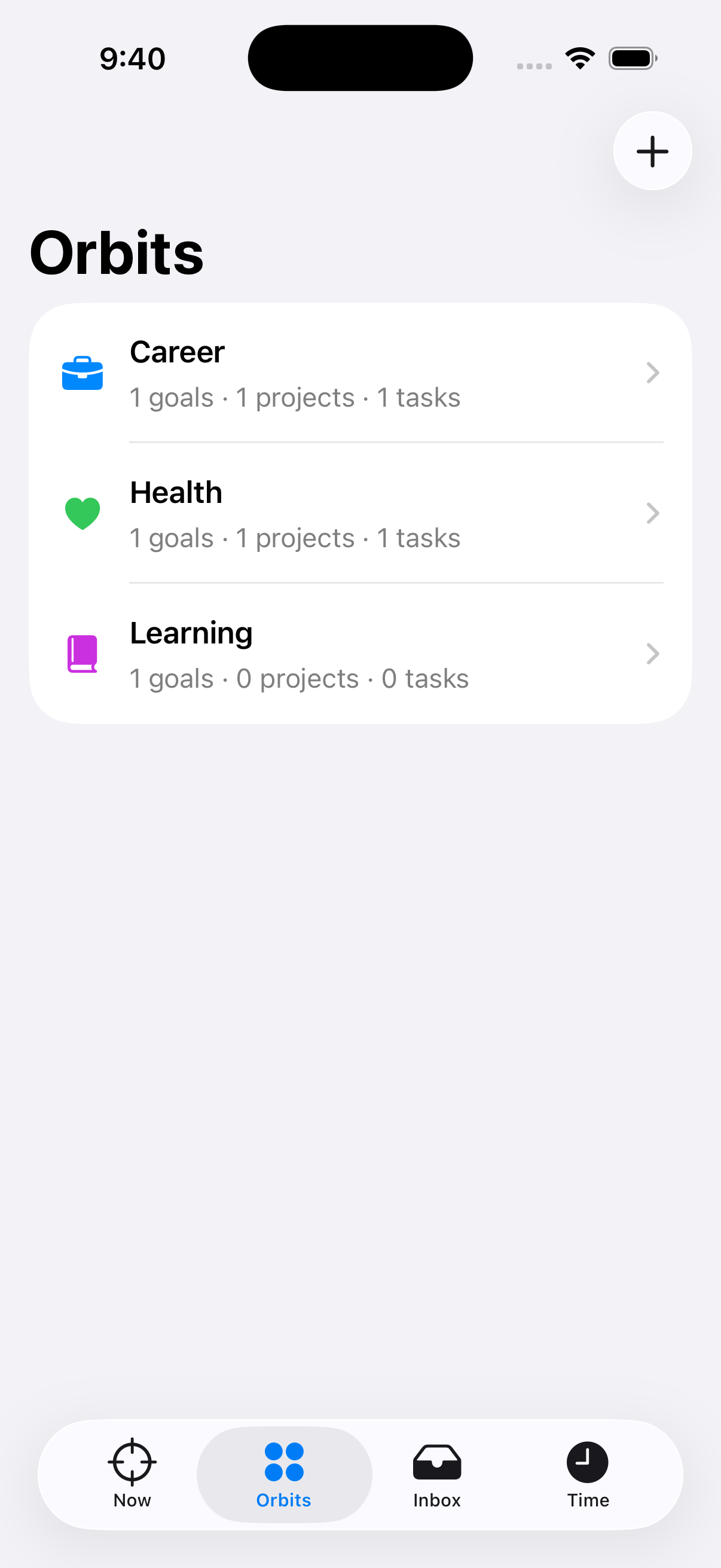 FROM THE ORBIT REPOSITORY · iOS
Tasks, goals, available time, and energy become inputs to a local decision.
Software should respect your attention as much as your data.
The owner has one half of the story. The finder has the other. Connecting them needs useful context, without exposing private identifying details.
THE EXPLORATIONWeighted matching compares category, name, description, location, color, and time. Private verification checks identifying details on-device; return coordination gives a match somewhere to go next.
PROJECT STATEiOS implementation
Explore Lost & Found on GitHub ↗A lost report and a found report describe an item from different perspectives.
A match is only useful if people can trust the next step.
A property, a payment, and a complaint mean different things to a tenant and a landlord. A shared system still needs to respect those different perspectives.
THE EXPLORATIONA monorepo separates the public site and three role-specific applications, backed by a NestJS API. The blueprint covers properties, tenancy, complaints, and manual payment verification.
PROJECT STATEApplication monorepo · documented blueprint
Explore RentFlow on GitHub ↗The tenant experience brings payments, tenancy, and requests into one place.
One source of truth can have more than one point of view.
Collaboration creates value long before it creates a finished product. OICE explores how contributions and funding decisions can leave an inspectable trail.
THE EXPLORATIONAI evaluates contributions with recorded reasoning. Ethereum escrow holds funding until approved milestones, while a lifecycle graph connects contributors, proofs, and rewards.
PROJECT STATETestnet protocol · deterministic demo mode
Explore OICE on GitHub ↗Code, research, design, or testing enters the project with supporting proof.
A reward means more when you can trace the reasoning behind it.
Digital ownership creates a difficult tension: protect assets today, while making a deliberate path for the people who may inherit them.
THE EXPLORATIONAn Ethereum vault pairs guardian consensus with proof-of-life signals. Encrypted letters, videos, and voice notes extend the idea beyond financial assets into personal legacy.
PROJECT STATEETHGlobal project · Base Sepolia testnet
Explore LegacyChain on GitHub ↗ILLUSTRATIVE 2-OF-3 GUARDIAN VOTE
Trust takes more than one voice.
Vote to explore the threshold. No wallet or transaction.A vault connects an owner, chosen beneficiaries, and encrypted personal content.
Trust is a human problem before it is a protocol problem.
Large infrastructure requirements make AI less accessible. This project starts with a smaller model and a clean interface that can grow with the application.
THE EXPLORATIONThe first milestone serves local model chat through FastAPI and llama.cpp using GGUF models. Document retrieval and isolated company knowledge bases are roadmap work, not completed features.
PROJECT STATEMilestone 1 · local chat API
Explore Compact SLM on GitHub ↗A chat message reaches the FastAPI service through a REST endpoint.
Constraints can be the starting point of the architecture.
An exception is a symptom, not always the cause. Repairing code needs a loop that can inspect behavior, make a change, and check what actually happened.
THE EXPLORATIONA FastAPI repair engine combines semantic checks, AST transformations, and LLM fallback. The editor exposes patches, iteration logs, and output; a no-change guard bounds unproductive loops.
PROJECT STATETryCatchMe · autonomous repair engine
Explore TryCatchMe on GitHub ↗while low <= high:
mid = (low + high) // 2
if values[mid] < target:
low = midThe pointer can get stuck on the same index.
Execution output and semantic checks provide evidence for the next attempt.
A convincing patch still needs to survive execution.
Networks split. Writers disagree. Messages arrive late. A distributed database needs a principled way to bring those divergent histories back together.
THE EXPLORATIONA Rust backend and Next.js dashboard expose peers, conflict resolution, and replication. Network partitions, concurrent writes, and chaos controls make convergence visible.
PROJECT STATEDatabase experiment · observability dashboard
Explore Conflict-Free OLTP on GitHub ↗Disconnected peers continue making local changes without a shared timeline.
The interesting part starts when the network stops cooperating.
Some ideas make more sense
when you play with them.
Let two writers disagree. Change the delivery order. Send the same operations twice.
This working counter model lets you explore one idea behind Conflict-Free OLTP: independent histories can converge.
The full database project ↗[2, 0][0, 3]Add operations independently, then bring the replicas together.
A shared counter begins at zero. Two replicas can update their own component without waiting for each other.
A G-counter illustrates convergence here. A complete OLTP system needs additional transaction, constraint, and durability guarantees.
From the interface to the infrastructure.
I like understanding how the pieces fit.
From responsive web products to native Apple interactions. I care about the small distance between intent and action.
Exploring the foundations: operations, causal ordering, deterministic merge, and state that can be replayed.
APIs, data models, and dependable services that make a product possible.
Building the retrieval, tools, and product experience around language models.
Shortening the distance between a hunch and feedback. Build, observe, change, repeat.
The through line isn’t a particular technology.
It’s wanting to see how far an idea can go.